Featured Post

LIFE

Introduction The question of what life and how it began has been at the center of scientific inquiry for centuries. Defining lif...

Thursday, October 24, 2024

LIFE


Introduction


The question of what life and how it began has been at the center of scientific inquiry for centuries. Defining life remains complex, but it is generally understood as a process involving self-replication, energy utilization, and evolution. For decades, scientists have wondered... what makes Earth uniquely suited for life. Among the critical factors is Earth's position within the "Goldilocks zone"—a region where temperatures are just right for liquid water, a necessity for life as we know it, to exist. This concept extends beyond our planet as we continue to search for life elsewhere, using tools such as the Kepler Space Telescope, the transiting exoplanet survey satellite (TESS), and investigating phenomena like extremophiles on Earth all play a role in our understanding of life and search for life on other worlds.

Ingredients of Life


On earth, life is abundant with some sources stating that we have discovered over 8.7 million species. The more impressive statistic is that there is about 80% of species living on earth that are still undiscovered. What began it all? The three key ingredients for life are water, energy, and organic molecules—are found across many environments on Earth from the depths of the ocean to the most arid deserts on the planet, life thrives and may exist elsewhere in the universe. For the best chance of life as we know it, planets need to be within the habitable zone, often referred to as the "Goldilocks zone". This is the region around a star where conditions might be just right for liquid water to persist on a planet's surface. This zone is neither too hot nor too cold, making it critical for the development of life. 
Around our very own star, there are two planets that inhabit this zone: Earth and Mars. However, today, science suggests that liquid water does not and cannot exist on the surface of Mars. Just being in the habitable zone does not mean that a planet is guaranteed to have running liquid water. The surface of Mars tells us about a time where the planet was overflowing with as much running water to cover one fifth of the planet. Evidence suggests that 2.5 billion years ago Mars had liquid water due to scientists finding Martian pebbles in the beds of large stable water networks, water frozen in the ice caps, large glacial sheets under the surface of Mars near the equator, and water chemically bonded to different compounds such as clays and carbonates called hydrated minerals. These phenomena aren't just occurring in our own back yard. Thanks to our arsenal of space telescopes looking abroad and orbiters zooming through our solar system, we have discovered many exoplanets in Goldilocks zones and interesting moons in our own solar system showing hope that life could exist beyond Earth.

The Origin of Life on Earth


Life on Earth is believed to have originated around 3.8 to 4 billion years ago, in an era where the planet was bombarded by meteorites and subject to extreme volcanic activity. This primordial Earth, often referred to as the Hadean and early Archean Eons, provided the right conditions for life to emerge. While the exact mechanisms of abiogenesis (life from non-life) remain a topic of scientific debate, the most widely accepted theory is that life began deep within the oceans, around hydrothermal vents. These vents, rich in minerals and energy, provided a stable environment where simple organic molecules could form more complex structures, eventually leading to the first forms of life. These life forms were likely simple, single-celled organisms resembling modern extremophiles, which thrive in similarly hostile environments today. Over time, the advent of cyanobacteria around 3 billion years ago marked a shift, as these organisms' harnessed sunlight through photosynthesis, dramatically increasing atmospheric oxygen levels. This transition, known as the Great Oxygenation Event, allowed for more complex multicellular organisms to evolve called eukaryotes. The diversification of life forms continued throughout Earth's history, leading to the explosion of biodiversity we see today.

The Search for Life Beyond Earth


With Since the mid-20th century, humans have speculated whether we are alone in the universe. Early literary works, such as H.G. Wells' The War of the Worlds, captured imaginations, while later films like 2001: A Space Odyssey and Close Encounters of the Third Kind explored humanity's fascination with extraterrestrial life. The secretive nature of military research facilities, such as Area 51, has only fueled these speculations. While much of the speculation remains within the realm of fiction, scientific efforts to find life elsewhere have made significant strides in recent decades with missions like the SETI initiatives, Kepler space telescope missions, more recently, the James Webb Space Telescope, and many more are all peering into the cosmos in the search for planets beyond our solar system; many of which that could be in their own habitable zone.


The Discovery of Exoplanets: Kepler Mission


One of the most significant advancements in the search for extraterrestrial life came with the discovery of exoplanets—planets outside our solar system. NASA’s Kepler Space Telescope, launched in 2009, was designed specifically to search for Earth-sized planets in or near the habitable zones of their stars. Kepler detected exoplanets by observing the slight dimming of a star’s light when a planet passes in front of it, a method known as the transit method. Over the course of its mission, Kepler discovered over 2,300 confirmed exoplanets, many of which reside in the habitable zones of their respective stars, potentially harboring conditions suitable for life. The criteria for determining the habitability of exoplanets extend beyond their position in the Goldilocks zone. Scientists also examine the planet’s atmosphere, surface conditions, and potential for water. One of the most promising discoveries in recent years is the TRAPPIST-1 system, located about 40 light-years from Earth. This system contains seven Earth-sized planets, three of which lie within the habitable zone. These planets are excellent candidates for further investigation because they may possess liquid water and atmospheres capable of supporting life.


Hints of Life in Our Solar System


Life may not be as far from us as we think. Within our own solar system, there are several promising locations where microbial life could exist. Recently, the detection of phosphine—a potential biomarker for life—within the clouds of Venus has reignited discussions about the possibility of life on other planets. Phosphine (PH₃) is a gas typically associated with biological processes, and its detection in Venus's harsh environment has left scientists puzzled. Although Venus’s surface is too hot for life as we know it, the upper atmosphere may harbor microbial life in a more temperate environment. The recent detection of phosphine in Venus's atmosphere has ignited a heated debate among scientists about the potential for life on the planet. While some argue that the harsh conditions—extreme temperatures and pressure—make Venus an unlikely candidate for life, others believe the presence of phosphine and ammonia could indicate microbial activity high in the atmosphere. Initial findings in 2020 were controversial, with skeptics questioning the data, but new measurements from advanced telescopes have strengthened the case for these gases. Some researchers suggest that ammonia could help neutralize the extreme acidity of Venus's clouds, making it more hospitable for life. However, the origins of both phosphine and ammonia remain unclear, with possibilities ranging from unusual atmospheric chemistry to volcanic activity, leaving the scientific community eager for further exploration and understanding. Similarly, Mars, once home to flowing rivers and lakes, is another candidate. Although now a frozen desert, evidence of complex carbon compounds, methane emissions, and volcanic activity suggest that Mars may have been habitable in the not-so-distant past. Methane, a gas often associated with biological processes, continues to be detected in the Martian atmosphere, raising the possibility that life may still exist beneath the surface.

Extremophiles: Life in Extreme Environments


Earlier we spoke about Earth being home to extremophiles—organisms that thrive in conditions previously thought to be uninhabitable. From the scalding heat of hydrothermal vents to the frigid depths of Antarctica, extremophiles demonstrate that life can persist in the harshest environments. The most famous example, the tardigrade, can survive in near-vacuum conditions and endure extreme temperatures. This raises the question: Could life exist in the extreme environments of other planets or moons? Jupiter’s moon Europa and Saturn’s moon Enceladus are considered the most promising locations in the search for extraterrestrial life. Both moons are believed to harbor vast subsurface oceans beneath their icy crusts, kept warm by tidal forces and potential hydrothermal activity. These environments could mirror the conditions found around Earth’s hydrothermal vents, where life first began.


Europa: A Promising Candidate for Life


Of the two moons, Europa is the most promising. Its surface is composed of a thick layer of ice, which scientists believe covers a vast ocean beneath. The surface of Europa is smooth, with very few impact craters, suggesting that tectonic forces and interactions with Jupiter’s gravity may be causing the ice to shift and renew itself. Despite the high levels of radiation from Jupiter’s magnetic field, scientists believe that life could exist in the moon's subsurface ocean, potentially sustained by volcanic activity on the ocean floor. To investigate these possibilities, NASA launched the Europa Clipper mission in October 2024. The Europa Clipper will conduct detailed flybys of the moon, gathering data on the thickness of its icy shell, its composition, and its geological activity. The mission aims to determine whether Europa’s subsurface ocean could support life, making it one of the most anticipated space missions of the decade.


Conclusion


In conclusion, the quest to understand life—its origins, its conditions, and its potential beyond Earth—remains one of humanity's most profound inquiries. From the fundamental ingredients of water, energy, and organic molecules to the intricate balance required for life to flourish, our exploration has revealed both the uniqueness of Earth and the possibilities that life exists elsewhere in the universe. The advancements in technology and missions like Kepler and the James Webb Space Telescope have broadened our horizons, identifying numerous exoplanets in habitable zones and reinvigorating the search for life in our own solar system, notably on Venus and Mars. Furthermore, the study of extremophiles on Earth exemplifies nature's resilience, hinting that life may thrive in environments previously deemed inhospitable. Ultimately, the intersection of scientific discovery and curiosity fuels our enduring quest: Are we alone in the universe, or are we part of a vast cosmic community yet to be discovered?


Thank you for reading and I would appreciate if you checked out my social media below! Also on the right-hand side of your screen is a Follow button! If you liked what you read, please share with your friends! If you want to see more, follow my blog so you can be updated when I make a post! 

Twitter @SpaceTalk365
Facebook Spacetalk365
For more click here! Home Page


References:


Choi, C. Q. (2016, October). Water on Mars: The story so far. NASA Astrobiology. https://astrobiology.nasa.gov/news/water-on-mars-the-story-so-far/

Cooper, K. (2024, August 2). Venus may be able to support life, new atmospheric evidence suggests. Space.com. https://www.space.com/venus-atmosphere-phosphine-evidence

Extremophiles. "Biolab Environmental Testing." https://biolabtests.com/extremophiles/.

Garcia-Pichel F, Zehr JP, Bhattacharya D, Pakrasi HB. What's in a name? The case of cyanobacteria. J Phycol. 2020 Feb;56(1):1-5. doi: 10.1111/jpy.12934. Epub 2019 Nov 15. PMID: 31618454; PMCID: PMC7065140.


Greaves, J. S. et al. "Phosphine Gas in the Cloud Decks of Venus." Astronomy & Astrophysics, vol. 644, 2021, https://www.aanda.org/articles/aa/full_html/2021/01/aa39932-20/aa39932-20.html.

Holmberg, T. J. (n.d.). 5.1.3: Evidence for early life. In [Unit 5]. Northwestern Connecticut Community College. https://[5.1.2: Origins of Life - Biology LibreTexts]

NCBI Bookshelf. "The Origin of Life." National Center for Biotechnology Information, https://www.ncbi.nlm.nih.gov/books/NBK230211/.

NASA Astrobiology Institute. (2018, August 8). About this site. https://astrobiology.nasa.gov/nai/about-this-site/index.html

NASA. (n.d.). Kepler mission. NASA. https://www.nasa.gov/mission_pages/kepler/overview/index.html

NASA Science. "What is the Habitable Zone or ‘Goldilocks Zone’?" NASA, https://science.nasa.gov/exoplanets/what-is-the-habitable-zone-or-goldilocks-zone/.

NASA Science. "Kepler and K2 Missions." NASA, https://science.nasa.gov/mission/kepler/.

NASA. (2024). Ingredients for life. Europa. https://europa.nasa.gov/why-europa/ingredients-for-life/

Sweetlove, L. Number of species on Earth tagged at 8.7 million. Nature (2011). https://doi.org/10.1038/news.2011.498

University of Chicago. "The Origin of Life on Earth, Explained." https://news.uchicago.edu/explainer/origin-life-earth-explained.

Walker, L. N. (2014, July 15). James Webb and the search for life beyond Earth. Astrobiology Magazine. https://www.astrobio.net/research-highlight/james-webb-and-the-search-for-life-beyond-earth/

Saturday, June 8, 2019

Hidden Planets in Our Galaxy: 18 Terrestrial Planets Discovered

Hidden Planets in Our Galaxy: 18 Terrestrial Planets Discovered

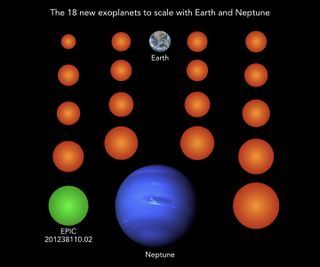
 A diagram showing the sizes of the newly identified planets compared to Earth and Neptune. Only one of the 18 planets is at a distance from its star that could potentially allow liquid water to survive on its surface.
This diagram shows the newly discovered exoplanets compared to the Earth and Neptune. (Photo Credit: NASA/JPL (Neptune) NASA/SOAA/GSFC/Suomi NPP/ Norman Kuring (Earth), MPS/Rene Heller)

Using the Kepler Telescope, Scientists have collected data on 18 exoplanets. Most of the planets discovered orbit close to their parent star and have varying surface temperatures that exceed more than 1,800 degrees Fahrenheit (1000 Degrees Celsius). One planet in particular orbits a red dwarf star in the area scientists dubbed "the habitable zone". The habitable zone is the area in which a planet could host liquid water on its surface, as it orbits its parent star but this does not mean that life could flourish on this planet. This world would be particularly difficult for life to develop on due to the fact that red dwarfs emit strong x-rays that make it hard for even the hardiest of microbes to develop.

K2 is the computer  program developed by scientists where Kepler space telescope uses solar winds to stabilize the telescope's pointing in a direction, examining a field of view for months. Using this method, Kepler has examined more than 100,000 stars, including 517 stars with planets orbiting them. Among the planets discovered using this method was the famous TRAPPIST-1 system (CLICK HERE: to read more about TRAPPIST-1). Researchers decided to look at the data gathered with this method using a new data processing algorithm.

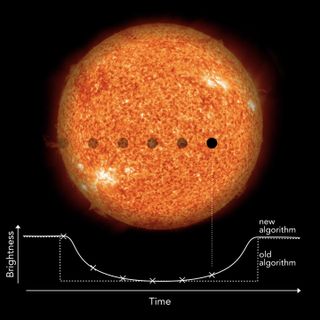
Rene Heller, an astrophysicist at the Max Planck Institute for Solar System Research stated "In reality, however, a stellar disk appears slightly darker at the edge than in the center. When a planet moves in front of a star, it therefore initially blocks less starlight than at the mid-time if the transit. The maximum dimming of the star occurs in the center of the transit just before the star becomes gradually brighter again."


Kepler data identifies the exoplanets by spotting small dips in brightness caused when a planet passes between a star and the telescope. Scientists are developing new algorithms to try and uncover more planets within the data.
(Image: NASA/SDO (Sun), MPS/Rene Heller)

The reason why this new algorithm was created was to try and create a more realistic dimming pattern as a planet transits across the face of a star. Using this new algorithm it became easier to detect smaller planets. The new planets discovered range from just slightly smaller than the Earth to nearly double the size of the Earth. The new algorithm even makes it easier for scientists to discover planets when fluctuations of light from a star is altered by sunspots.

If we continue to use this algorithm and discover newer ways to interpret the Kepler data, more planets could be out there, waiting to be discovered. Who knows, some may even harbor life.

Thank you for reading and I would appreciate if you checked out my social media below! Also on the right-hand side of your screen is a Follow button! If you liked what you read, please share with your friends! If you want to see more, follow my blog so you can be updated when I make a post!

Twitter @SpaceTalk365
Facebook SpaceTalk365
For more click here!!! Home Page: Spacetalk365 

Sunday, May 12, 2019

Simple Guide to our Solar System: Mercury

Mercury

The Basics

Mercury is the smallest planet in our solar system and the closest planet to our Sun. An interesting fact, the Sun would appear three times as large in the sky and 11 times brighter than here on Earth.  But despite its close proximity to the Sun, it is not our hottest planet. The crown in that category belongs to Venus, Earth's twin sister. Mercury gets its name from the Roman God Mercury because it is the fastest planet in our solar system. Mercury completes its year around the Sun in only 88 Earth days. This means that the planet wisps around the Sun at a staggering 112,000 mph (180.000 km/h). Now you can see why it is named after the Roman God Mercury.

Characteristics

Mercury has a radius of 1,516 miles (2,440 km) and is only 36 million miles (58 million km) from the Sun. It takes light 3.2 minutes to travel from the Sun to Mercury and that is amazing. Mercury has an egg-shaped orbit known as an eccentric orbit. Other notable characteristics of Mercury are as follows:
  • Completes one rotation every 59 Earth days
  • Mercury does not experience seasons 
  • One of 4 terrestrial planets in the solar system
  • Aside from how close it is to the Sun, Messenger, a spacecraft sent by the planet has discovered water at Mercury's poles.
  • It is the smallest planet in the solar system, only slightly larger than the Earth's moon.
Mercury is a terrestrial planet, one of 4 in the inner solar system. Terrestrial comes from the Latin phrase "Terra" which means Earth. The average density of the planet is 5.427 g/cm. Mercury's make up is similar to that of Earth's. Mercury has a molten Iron core surrounded by a mantle of superheated rock which is then surrounded by a crust rock layer.

NASA
Mercury, with colors enhanced to emphasize the chemical, mineralogical and physical differences among the rocks that make up its surface.

The surface of Mercury is an unforgiving one, with temperatures reaching close to 900 degrees in the sunlight. Although the surface is scorching hot, it is still not the hottest planet in our solar system! Can you guess which planet holds that title? Comment below! 

Interestingly enough, Mercury joins Earth as a planet with active plate tectonics. The inner mantle of the planet is cooling causing the planet to shrink. This action causes the surface of the planet to crack creating huge mountain ranges and rift valleys.

Mercury has a very thin exosphere that is composed of 42 percent oxygen, 29 percent sodium, 22 percent hydrogen, 6 percent helium, 0.5 percent potassium, with trace amounts of other elements. This exosphere is formed due to the intense solar winds and meteor impacts pounding the surface, blowing off atoms into space.

Thought Mercury was a complex planet, wait until you see the next stop on our journey! Stay tuned for the planet, Venus!

Click here to read about Venus!!


Thank you for reading and I would appreciate if you checked out my social media below! Also on the right-hand side of your screen is a Follow button! If you liked what you read, please share with your friends! If you want to see more, follow my blog so you can be updated when I make a post! 

Twitter @SpaceTalk365
Facebook SpaceTalk365
For more click here!!! Home Page: Spacetalk365 

Saturday, May 11, 2019

Betelgeuse Will Supernova!

Betelgeuse Will Supernova!
By: Aubrey Pennington


A direct sky image of Betelgeuse. The star is shedding mass as it approaches exploding into a supernova.

(Image: © ESO/Digitized Sky Survey 2. Acknowledgement: Davide de Martin)


Betelgeuse is a bright star located in Orion. It is one of the largest known stars we have observed with a diameter of 700 times the size of the Sun. That is a whopping 600 million miles in diameter. It is classified as a red super giant and it is about 640 light years from Earth. Betelgeuse has a surface temperature of 6000 degrees Fahrenheit (3,316 degrees Celsius) which is less when compared to the Sun’s surface temperature of 10,000 degrees Fahrenheit (5,538 degrees Celsius). This low temperature is what gives the star its red glow. Betelgeuse is only a baby star compared to our Sun (4.6 billion years old), at only 10 million years old.
So, what exactly is happening to Betelgeuse, well it is about to go Supernova. Betelgeuse is shedding so much mass (seen in the picture above). This phenomenon is known as Stellar Mass Loss. It is observed in some massive stars where their mass is ejected into space. We do not know much information as to why stars go through this phase but my speculation, after reading different sources, is that once the stars run out of hydrogen to fuse and begin to fuse heavier elements such as helium. This causes the star to become hotter and it begins to swell. This causes the surface of the star to become weak and it begins to leak mass through the surface and eject it into space. But what we do know for sure, is that Betelgeuse is its final stages of life. Looking at the track of a Sun with at least 25 times the mass we can see that Betelgeuse is a Super red giant and we are expecting it to go supernova. Betelgeuse began to shed its outer layers and we began measuring what we could in 1993 for about 15 years. We noticed that Betelgeuse shed about 15 percent of its mass in that short amount of time.


Dr Haley Gomez explains how Herschel will help us understand the life-cycle of stars

I have written a blog post on Supernovae here: Supernova. I will briefly reiterate a little below:
The before a supernova can happen, the star must stop fusing hydrogen at the core. It will expand and become a red giant and the core will become hot enough to begin fusing helium into carbon. This process in massive stars is like stars like our Sun. But this is where the similarities end. The star will continue to fuse carbon into heavier elements such as oxygen, neon, silicon, magnesium, sulfur, and finally iron. Once a star begins to fuse atoms into iron, the star is at its end and it can no longer burin fuel. The star then collapses under its own gravity and the iron core begins to heat up. In a fraction of a second, the Earth sized iron core shrinks to about 6 miles across (10 kilometers). The outer layers of the star will fall inwards onto the core which will heat it to billions of degrees and then…. BOOM. The star explodes releasing large amounts of energy and tons of materials into space forming interstellar clouds. What remains of the star can form a neutron star or a black hole depending on how massive the star was.

With all that said, we know what will happen to Betelgeuse, but I am sure you want to know exactly how long that will be from now? The number is difficult to gauge but the consensus from multiple sources say in about 100,000 years Betelgeuse will go supernova.


Thank you for reading and I would appreciate if you checked out my social media below! Also, on the right-hand side of your screen is a Follow button! If you liked what you read, please share with your friends! If you want to see more, follow my blog so you can be updated when I make a post!

Twitter: @SpaceTalk365
Facebook: SpaceTalk365

For More Click Here: Home Page: SpaceTalk365

Wednesday, July 18, 2018

Astronomers Accidentally Discover 12 Moons Orbiting Jupiter

Astronomers Accidentally Discover 12 Moons Orbiting Jupiter


ROBERTO MOLAR CANDANOSA/CARNEGIE INSTITUTION FOR SCIENCE 

Astronomers have accidentally stumbled across 12 moons previously undetected in orbit around Jupiter, bringing the new total in orbit around the massive planet to 79.
Scientists were looking for the evasive object, Planet X. This planet lies just beyond Pluto and it is roughly the size of Mars. While searchin
g, scientists at the Chile’s Cerro Tololo Inter-American Observatory found 12 bodies previously undetected orbiting Jupiter.

These moons are incredibly small in size which is the most likely reason that they were able to evade detection for so long. The moons range in size from approximately 0.5 to 2 miles across. Of the 12 moons, 9 of them are in a retrograde orbit meaning they orbit Jupiter opposite of the planets rotation. 2 moons are in a prograde orbit meaning they orbit Jupiter in the same direction of it's rotation. Last but not least we have a moon in an orbit so weird around the planet that it is unlike any other moon that orbits Jupiter. This moon is called Valetudo, named after the Roman Goddess of Health and Hygiene.

The discovery of these moons took the combined effort of Chile’s Cerro Tololo Inter-American Observatory and 4 other telescopes over a year to finalize this discovery.
Space will never cease to amaze and captivate us. Jupiter is just one amazing, powerful giant and we look forward to discovering more and more in and outside of our celestial backyard.
Thank you for reading and please follow me on these social media platforms.

Thank you for reading and I would appreciate if you checked out my social media below! Also, on the right-hand side of your screen is a Follow button! If you liked what you read, please share with your friends! If you want to see more, follow my blog so you can be updated when I make a post!

Twitter: @SpaceTalk365
Facebook: SpaceTalk365

For More Click Here: Home Page: SpaceTalk365


Monday, August 21, 2017

Cassini: The Finale

Cassini: The Finale

Saturn: Cassini, NASA

Voyager 1, Voyager 2, and Pioneer 11 have all passed by Saturn in the past, but no other spacecraft has revealed to us more information about Saturn than Cassini and its pal the Hyugens Probe. Cassini was the first probe to initiate an in depth look at Saturn and became the first probe to orbit the planet. We have discovered many things about Saturn's rings, the constantly changing magnetosphere,  and Titan's surface, just to name a few. To me, the most exciting discoveries to be made lie within Saturn itself and many more to find on the surface of it's amazing moon Titan. This is where the Hyugens Probe comes in to play. This probe was launched onto Titan's surface in 2005.

Huygens Probe: NASA

Since the Cassini mission began, it has seen two mission extensions which allowed for more flybys. The first extension was a two year mission called Cassini Equinox mission. This mission allowed Cassini to orbit Saturn and show us brilliant displays of Saturn's rings that were never before seen. The second extension was a seven year long extension called the  Cassini Solstice Mission. This mission will be concluded with a phase called The Grande Finale. The Grande Finale is characterized by 22 dives between Saturn's cloud tops and innermost ring before it goes dives into the planets atmosphere.

Cassini Launch: NASA

Sadly, every mission has to come to an end, this mission particularly due to a dwindling fuel supply and other factors. So before Cassini plunges to its demise, we can take a look at some of Cassini's notable achievements throughout its  20 year lifespan. Cassini was launched October 15th, 1997. The trip to Saturn took nearly 7 years to complete. Since Cassini's launch, the spacecraft has analyzed, studied, and captured some pretty amazing things. Cassini joined the Galileo spacecraft in December 2000, giving scientists more information about the Jupiter system. 3 months prior to arriving to Saturn, Cassini discovered 2 new moons on May 31st 2004 bringing the total count to 60 moons. After becoming the first craft to orbit Saturn, nearly 4 months later, Cassini's lenses pointed towards Titan and began studying the atmosphere and in 2005, the Huygens probe makes it safely to Titan's surface, revealing extraordinary information about the moon. Cassini discovered that most of the material in Saturn's E ring is composed of particles emanating from a moon named Enceladus and soon after that finding, we discovered that Enceladus has liquid water on the surface shooting from geysers, lakes on Titan. Cassini is an amazing craft, all of the findings were discovered during the primary mission.

Cassini has provided information of the moons Titan and Enceladus. And with each pass, we learned more and more about the two moons. Enceladus has liquid water on it's surface, more than 100 geysers that shoot ice particles out into space, geologic activity, hydrogen gas leaking in to the surface oceans, and hydro-thermal activity on the ocean floor, which can be an energy source for life. Titan has small and large lakes and a Sea of methane. Titan is a very rocky moon with mountains that exceed heights of 10,000 feet.

Cassini is readying itself for the final phase of this mission, deemed the Grand Finale. During this phase of the mission, Cassini will orbit closer to the planet than ever before during any other mission - diving between the planet and it's rings. This will help us learn about the region between the planet and it's rings and learn about the upper atmosphere of Saturn. According to NASA, Cassini will gather information that was too risky to gather during the early parts of the mission. Data such as Saturn's gravity, magnetic fields, internal geology, how fast the planet is rotating, new information about the ring system, icy particles in Saturn's atmosphere, and ultra close pictures of Saturn's rings and clouds.

Cassini's Path during ring dive: NASA

Everything Cassini finds will be beamed back to Earth, but there is still the question as to why scientists at NASA have decided bring Cassini to an end. Rocket fuel used to navigate Cassini over its 7 year journey and nearly 13 year orbit around Saturn, is running low. If Cassini's mission is not brought to an end, we will be unable to adjust it's course later on which could end in colliding into one of Saturn's moons. In order to avoid the possibility of the collision with a moon, NASA has decided to dispose of Cassini in Saturn's atmosphere. It is my understanding that once Cassini enters Saturn's atmosphere, much like when something enters Earth's atmosphere, it will burn up like an asteroid or meteorite. Cassini will be collecting data of Saturn until the end. Disposing of Cassini in this manner will allow us to preserve and protect the possible life harbingers Titan and Enceladus. 

Thanks to Cassini, we were able to view Saturn in ways never seen before. We have been able to study the composition and temperature of Saturn's upper atmosphere, and Cassini has provided us with live and up close pictures of Saturn's beautiful storms, we learned that there are seven year seasons, and we learned a lot about it's beautiful moons. In the 13 years Cassini orbited Saturn, we have learned more than we possibly ever will about Saturn.


Godspeed Cassini.

Thank you for reading and I would appreciate if you checked out my social media below! Also, on the right-hand side of your screen is a Follow button! If you liked what you read, please share with your friends! If you want to see more, follow my blog so you can be updated when I make a post!

Twitter: @SpaceTalk365
Facebook: SpaceTalk365

For More Click Here: Home Page: SpaceTalk365

Wednesday, July 12, 2017

The Fascination with Space

The Fascination with Space

 
Image Credit: NASA/ESA/HEIC and The Hubble Heritage Team (STScI/AURA)

        Humans love to explore. In fact, we have seen to the furthest reaches of our universe, to where stars and galaxies are being born, and where time begins. We have witnessed the beginning of creation first hand. Space has been our addiction for centuries. We have explored more of the universe that we have explored our own planet. For example, the ocean covers 70 percent of the Earth's surface and we have only explored less than 5 percent of it. The Mariana Trench is the deepest place on our planet. It is the largest most unexplored place on the Earth. Scientist call It “the last, great, unexplored frontier”.  Down in the depths of this dark and dangerous trench are possibly thousands upon thousands of new species to be discovered. In the 4 hours, it took a group of researchers to dive the nearly 7 miles to the depths of the Mariana trench, there were dozens of new species discovered. Scientists have learned that life could thrive in yet another extreme environment. How could this be? When scientists look in extreme environments, we see life prosper in ways that defy our understanding. Life adapts to survive.

         Life can thrive in the most extreme and unexpected environments. The life that thrive in these environments are called extremophiles. These extremophiles can tolerate conditions that would kill other organisms. These organisms live in such places like volcanic hot springs, densely salted lakes, sulfuric acidic pools, frozen tundra, superheated boiling water, extreme water pressure, asphalt lakes, absence of oxygen and water, just to name a few. These discoveries have fueled our thirst for more. We have stepped out into the greatest challenge that man has ever faced and that is outer space. We will continue searching until we answer the question, “Are we alone?”.
Thermophiles, a type of extremophile, produce some of the bright colors of Grand Prismatic Spring, Yellowstone National Park

         Recently, with the aid of the Spitzer Space Telescope,  we have discovered 7 planets. The system has come to be known as the Trappist-1 system. This system has 3 planets in the habitable zone. These planets could possibly harbor life. On the surface of these planets, even though they are cooler than the Earth, there is the possibility of liquid water. If the planets have the right combinations of gasses and an atmosphere, they could be habitable for humans. When thinking about extremophiles, these 3 planets could have these hardy microscopic life forms.
Jupiter and Major Moons 


          Do you think the Trappist-1 system could harbor life? It will be interesting to find out. One day our curiosity will get the best of us and we will be in orbit around one of the worlds that orbit Trappist-1. There is an entire universe out there and more planets to discover. The exploration pushes forward and the quest to find life continues.

Thank you for reading and I would appreciate if you checked out my social media below! Also, on the right-hand side of your screen is a Follow button! If you liked what you read, please share with your friends! If you want to see more, follow my blog so you can be updated when I make a post!

Twitter: @SpaceTalk365
Facebook: SpaceTalk365


For More Click Here: Home Page: SpaceTalk365


Wednesday, February 22, 2017

SEVEN Earth Sized Planets Discovered!!!

SEVEN Earth Sized Planets Discovered!!!

An artist's concept image of the surface of the exoplanet TRAPPIST-1f. Of the seven exoplanets discovered orbiting the ultracool dwarf star TRAPPIST-1, this one may be the most suitable for life. It is similar in size to Earth, is a little cooler than Earth's temperature and is in the habitable zone of the star, meaning liquid water (and even oceans) could be on the surface. The proximity of the star gives the sky a salmon hue, and the other planets are so close that they appear in the sky, much like our own moon.

If you read the title, do not wipe your eyes, or double take! That does say SEVEN Earth sized planets discovered. It is one of the biggest discoveries of my life time in my own opinion. What makes this discovery so much more significant than all of the others. Well, Here's why!!


The Amount of Planets Discovered in One System

This system is different than most of the other systems discovered. There have been more than 3,400 exoplanets discovered since this program started. While the Kepler space telescope is the familiar exoplanet finder, the Spitzer Space Telescope takes the credit for this find. This is special because Seven planets were discovered at once, in the same system, with three of them being located in the habitable zone or "Goldilocks" zone. Which leads me into the point.


The Habitable Zone

Everyone has heard of the Habitable Zone! But, just what is the Habitable Zone? Well it is commonly referred to as the "Goldilocks" Zone. It is the zone where liquid water and possibly even life can be sustained. In our solar system, 3 planets exist inside of the Habitable Zone; Earth, Venus, and Mars. The problem with Mars is that it sits to the far end of our zone where it experiences freezing cold temperatures. Venus is on the front end of the Habitable Zone and it experienced the greenhouse effect and became so hot that all of the water that was there evaporated. In the newly discovered system TRAPPIST-1, the planets that exist in the Habitable Zone are TRAPPIST-1e, g, and f. TRAPPIST-1e is roughly the same size of the Earth and receives about the same amount of star light as the Earth.


Planet TRAPPIST-1e seems to have great potential for oceans, high oxygen concentration, and more Earth like features. This is why this discovery is so revolutionary. If that is not enough for you, there have been 3,449 confirmed exoplanets. NASA says that there are potentially 100 billion exoplanets out there to be discovered. How many do you think will be in the Habitable Zone?


The distance

This is quite possibly the most important criteria. These planets are 40 light-years away. What is a light year? A light year is the distance that light travels in one year. This is saying it would take 40 years, traveling at the speed of light, to reach one of these planets. How fast is the speed of light? That is a mind boggling 186,000 miles per SECOND! Sadly, we have not reached anywhere close to traveling at those speeds. I know what you are thinking, if the new planets are so far away, how come I am making such a big deal about this? Roughly 6 months ago, we discovered an exoplanet known as Proxima b. this exoplanet orbits our nearest neighboring star which is 4.2 light-years away. This system is only made up of that one exoplanet. Discovering the TRAPPIST-1 system just a mere 40 light years away, with SEVEN exoplanets, and THREE of those in the Habitable Zone, is a wonderful and revolutionary find when compared to the vastness of the universe.

Thank you for reading and I would appreciate if you checked out my social media below! Also, on the right-hand side of your screen is a Follow button! If you liked what you read, please share with your friends! If you want to see more, follow my blog so you can be updated when I make a post!

Twitter: @SpaceTalk365
Facebook: SpaceTalk365

For More Click Here: Home Page: SpaceTalk365


Tuesday, February 21, 2017

Stars in the Night Sky

Stars in the Night Sky

For some people, the stars offer solidarity and tranquility. For others, their perplexity offers something a little different. For an amateur astronomer such as myself, there are so many questions to be asked as I look up at the night sky. Why do some stars twinkle? Why are some stars bright and some dull? Well today, we will try to understand the immensity of the stars in the night sky.

What do we see when we look up?

The night sky is filled with beauty. When we look up we see a wide variety of things such as planets, galaxies, and other stars in our own Milky Way Galaxy. Simply put, it is pretty difficult to see other galaxies because our sky is riddled with stars from our galaxy. There is one galaxy that sticks out in the Northern Hemisphere called M31 and in the Southern hemisphere, there are two dwarf galaxies.

Throughout the year, we can see multiple planets. While not all planets are always visible at the same time, it is amazing they are even there. On a clear night we can see Venus, which if it is not the brightest star in the sky, it is on par with the brightest star in the sky. Somewhere near Venus is a much dimmer star and that is Mars. Jupiter will creep up around midnight and last until dawn and it is the second brightest planet that dominates the sky. If you catch Saturn right before dawn and look at it through a telescope you would be in awe. Saturn is absolutely breathtaking. And as the Sun rises, you can catch Mercury as it slips behind the Sun as the morning light fills the sky.

How can you Tell the Difference Between a Star and a Planet?

I can see how confusing this can be since all the bright little lights in the sky look exactly the same. The easiest way to differentiate between a planet and a star is as simple as this.

1. A star shimmers or "twinkles" and a planet stays one constant in their luminosity (brightness)
2. Planets typically follow the same path as the Sun and the Earth's Moon, whereas stars move around in the sky, but they do not rise or set.
3. Although planets and stars both shine, the planets only shine because they are reflecting the light back from our Sun. There are stars many times bigger than our own Sun. Even though they are bigger, they are much further away from us that their light does not shine as bright.
Spiekeroog and the Milky Way over the island. Picture credit: Kai Kröger


What makes a Star Twinkle?

The atmosphere has many layers. As the light from the distant stars would pass through those layers, the light gets refracted (bent) and when picked up by our eyes, our perception is a twinkle. An interesting thing to note as well, the stars closer to the horizon twinkle more than stars higher up in the sky. This is because there is more air the light has to travel through which means more refraction of the light. As for planets, they are close enough to the Earth, that the atmosphere does not affect the light that we see.

So no matter what reason you choose to look up at the sky, just enjoy the peace and solidarity, ask questions, and learn! Stars are more than white specks in the sky!

Thank you for reading and I would appreciate if you checked out my social media below! Also, on the right-hand side of your screen is a Follow button! If you liked what you read, please share with your friends! If you want to see more, follow my blog so you can be updated when I make a post!

Twitter: @SpaceTalk365
Facebook: SpaceTalk365


For More Click Here: Home Page: SpaceTalk365

Monday, February 20, 2017

What's Space Like in a Game


Space in a Game


I love video games. And I know a lot of others who do. I also love space, and I similarly know a lot of people who share that interest. If you fall in either (or both) of these categories, have I got a game for you! Kerbal Space Program, officially completed as of April 27, 2015, has been available as an Early Access game or demo from various platforms since December 15, 2014. The finished game is now available on PC, Mac, Xbox One,

Possibly one of the most realistic space simulators to date, this doesn't just give you a ship and throw you into the wild black yonder- instead, it puts you in direct control of an entire space exploration administration, akin to NASA or SpaceX. The main core of gameplay involves building all assortments of rockets, shuttles, spaceplanes and more with hundreds of lego-like pieces, then firing them into space to see what sticks. The cartoonish little green-yellow Kerbals who fly these ships are determined, brave, and probably not all that bright... I probably wouldn't get in a ship designed by you, to be fair. But this game, while funny and bright at first glance, holds a depth of real-world physics and orbital mechanics nearly unmatched in any game before or since. It also has an entire solar system for you to explore, complete with a sun and six planets, a planetoid (like Pluto), and nine moons, as well as asteroids! It includes three different gameplay modes; Career, Science, and Sandbox.

In Career mode, you build  your administration from the ground up, hiring astronauts, performing contracts to raise money, building rockets, experimenting and researching to unlock more advanced rocket parts, and making sure your popular opinion stays high enough to keep funding coming. The full space administration experience. Note: it's really hard.

In Science mode, you start out with the basic buildings and rocket parts, and have to unlock more parts and upgrades via experiments. You don't have to worry too much about money or public opinion in this mode, but it's still quite a challenge just to get off the ground and back... safely, at least.

In Sandbox mode, the system is your oyster. All parts and building upgrades are there for you from the start, it's just up to you to build the biggest, baddest space behemoth you can... that won't fall apart as it exits the atmosphere.

Overall, this game is incredibly fun for just about anyone, from the expert in orbital mechanics to the kid who just got a telescope for his birthday. The learning curve is pretty steep, I won't lie, but it's not impossible to eyeball it and hope for the best-  you just have to be persistent, and not care about your Kerbals coming home if you play this way. On my first mission, I missed the Mun (one of the two moons orbiting your starting planet, Kerbin) and was slingshot out of Kerbin's orbit, losing my first astronaut (RIP Jebadiah) as he was thrown into orbit around the sun. But if you're smart enough and feel like doing the math, or get good enough at eyeballing it, you can conquer the system.

Thank you for reading and I would appreciate if you checked out my social media below! Also, on the right-hand side of your screen is a Follow button! If you liked what you read, please share with your friends! If you want to see more, follow my blog so you can be updated when I make a post!

Twitter: @SpaceTalk365
Facebook: SpaceTalk365

For More Click Here: Home Page: SpaceTalk365


Wednesday, November 23, 2016

What is Rain like on Different Worlds?

Hey, did you know that it rains on different worlds?

On Earth when stuff falls from the sky, what do we see? Well, it varies depending on the temperature, but you can rest assured that what you see and feel is water. The stuff is everywhere! It comes in different forms such as liquid and a solid. So how is rain formed? Rain happens through a process called the water cycle. Simply put, water is evaporated from sources like rivers, lakes, and oceans and rises into the air. As temperatures cool, the water vapor condenses and forms a cloud! Once water is condensed into a cloud, the cloud forms water droplets which then form into water drops. Once these water drops are heavy enough most of it makes it back to the surface as rain and this is the never-ending loop of the water cycle.

In bad thunderstorms, the drops that begin falling back to the surface get blown back high into the atmosphere into freezing temperatures (This is an updraft). The drop begins to fall again gaining more moisture and getting bigger. This happens over and over until the drop is big enough to fall down to the surface as hail.
So we know what rain is like on our planet. What is it like on other worlds? Let's take a trip to the first stop in our adventure, the planet Venus. Venus is Earth's twin. It closely resembles the size of our home. Venus is the hottest planet in our solar system. It has an atmosphere that is composed mostly of carbon dioxide and clouds saturated with sulfuric acid. Sulfuric acid is a strong mineral acid. It is strong enough to eat through living tissues, stone, and even metal! Assuming you would be able to survive all other aspects of Venus' harsh environment, if you happen to get caught in this super concentrated sulfuric acid rain, it would be a very bad day. 

The next stop on our journey is a moon in the Saturn system called Titan. Titan is the largest moon in the Saturn system and the second largest in the solar system, second to Jupiter's moon Ganymede. Titan is a very complex world, in fact, scientists believe it is similar to how Earth would have looked in its early years. Its atmosphere is composed of 95% nitrogen and 5% methane. Titan has rivers, lakes, and even oceans composed of methane! In order for methane to exist in a liquid form it has to be extremely cold, on Titan it would be about minus 290 degrees F! Living on Titan would be relatively easy for humans. It is one of the least hostile places in our outer solar system. Protection from the cold and a breathing mask would be all you needed to live there. So, what would happen if you got caught in rain on Titan? No need to worry. If you happen to be exposed to the liquid methane, treating the exposure would be relatively the same as treating a natural gas exposure. Let's say you get the methane on your skin, if you rinse the area thoroughly with water, you will be fine. 

It has been rumored that it rains diamonds on the gas giants. Yes, I said diamonds! But before you begin to plan a trip to the outer solar system, just know that bringing back that amount of diamond back to this planet would make the jewel worthless! So I bet you are wondering "how in the world can it rain diamonds anywhere!?" Well, studies have shown that the gas giants have an abundance of carbon in their atmospheres in the diamond form. Lightning storms on these planets turn methane into soot, which is a form of carbon. The soot begins to fall toward the center of the planet being subjected to higher pressures and heat, it would then turn into diamonds and continue to fall to the center as hail would fall here on Earth. Sadly, the heat is so intense on Saturn and Jupiter that the diamonds do not stay in that form for long before melting and collecting in a molten sea at the core of the planet. The same cannot be said for Neptune and Uranus since the planets are much cooler. The diamond rains on these planets last much longer. None of this has actually been confirmed beyond the shadow of a doubt, but it is still cool to think about. 

Where ever you are, whenever it begins to rain, always think about bringing your umbrella! Thank you all for reading please check out my social media below and subscribe to the blog for updates when I post!

Thank you for reading and I would appreciate if you checked out my social media below! Also, on the right-hand side of your screen is a Follow button! If you liked what you read, please share with your friends! If you want to see more, follow my blog so you can be updated when I make a post!

Twitter: @SpaceTalk365
Facebook: SpaceTalk365

For More Click Here: Home Page: SpaceTalk365

Saturday, October 15, 2016

The Great Barrier Reef

The Great Barrier Reef is one of the most beautiful features on the planet. It is a 1,400-mile network of reefs off the coast of Australia. The reef is so immense, you can actually see this structure from space. Corals have been around for 500 million years. The Great Barrier Reef is relatively young at only about 500,000 years old with the newest formations being only 8,000 years old.

Recently, there has been talk about the reef dying. But this is nothing more than a hoax. The Great Barrier Reef is still very much alive, although it still in a great deal of stress. What's to blame for this stress? Prolonged elevated oceanic temperatures which can lead to bleaching of the corals. Bleaching occurs when prolonged high temperatures cause coral to expel their symbiotic algae (this alga actually lives inside of the coral's tissue developing a mutualistic relationship) turning them into snow-white skeletons. Corals can recover from this over time but some simply die. Divers on the Great Barrier Reef have spotted large areas with degraded coral, with some divers reporting the smell of rotting coral when they emerge from the water.

The Great Barrier Reef is very much alive and scientists are predicting they will be until the year 2050. This hoax brought attention to a scientific marvel. Hopefully, in the near future, we can reverse the effects of coral bleaching and bring the dying parts back to full vitality. The pictures below depict just a small fragment of the impressively large scale beauty of what is.. the Great Barrier Reef. 


Twitter @SpaceTalk365
Facebook SpaceTalk365
For more click here!!! Home Page: Spacetalk365 
Thank you for reading and I would appreciate if you checked out my social media!