Featured Post

LIFE

Introduction The question of what life and how it began has been at the center of scientific inquiry for centuries. Defining lif...

Showing posts with label Astronomy. Show all posts

Saturday, June 8, 2019

Hidden Planets in Our Galaxy: 18 Terrestrial Planets Discovered
Hidden Planets in Our Galaxy: 18 Terrestrial Planets Discovered

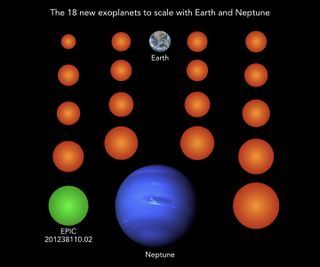
 A diagram showing the sizes of the newly identified planets compared to Earth and Neptune. Only one of the 18 planets is at a distance from its star that could potentially allow liquid water to survive on its surface.
This diagram shows the newly discovered exoplanets compared to the Earth and Neptune. (Photo Credit: NASA/JPL (Neptune) NASA/SOAA/GSFC/Suomi NPP/ Norman Kuring (Earth), MPS/Rene Heller)

Using the Kepler Telescope, Scientists have collected data on 18 exoplanets. Most of the planets discovered orbit close to their parent star and have varying surface temperatures that exceed more than 1,800 degrees Fahrenheit (1000 Degrees Celsius). One planet in particular orbits a red dwarf star in the area scientists dubbed "the habitable zone". The habitable zone is the area in which a planet could host liquid water on its surface, as it orbits its parent star but this does not mean that life could flourish on this planet. This world would be particularly difficult for life to develop on due to the fact that red dwarfs emit strong x-rays that make it hard for even the hardiest of microbes to develop.

K2 is the computer  program developed by scientists where Kepler space telescope uses solar winds to stabilize the telescope's pointing in a direction, examining a field of view for months. Using this method, Kepler has examined more than 100,000 stars, including 517 stars with planets orbiting them. Among the planets discovered using this method was the famous TRAPPIST-1 system (CLICK HERE: to read more about TRAPPIST-1). Researchers decided to look at the data gathered with this method using a new data processing algorithm.

Rene Heller, an astrophysicist at the Max Planck Institute for Solar System Research stated "In reality, however, a stellar disk appears slightly darker at the edge than in the center. When a planet moves in front of a star, it therefore initially blocks less starlight than at the mid-time if the transit. The maximum dimming of the star occurs in the center of the transit just before the star becomes gradually brighter again."
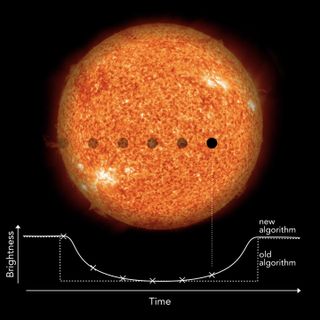


Kepler data identifies the exoplanets by spotting small dips in brightness caused when a planet passes between a star and the telescope. Scientists are developing new algorithms to try and uncover more planets within the data.
(Image: NASA/SDO (Sun), MPS/Rene Heller)

The reason why this new algorithm was created was to try and create a more realistic dimming pattern as a planet transits across the face of a star. Using this new algorithm it became easier to detect smaller planets. The new planets discovered range from just slightly smaller than the Earth to nearly double the size of the Earth. The new algorithm even makes it easier for scientists to discover planets when fluctuations of light from a star is altered by sunspots.

If we continue to use this algorithm and discover newer ways to interpret the Kepler data, more planets could be out there, waiting to be discovered. Who knows, some may even harbor life.

Thank you for reading and I would appreciate if you checked out my social media below! Also on the right-hand side of your screen is a Follow button! If you liked what you read, please share with your friends! If you want to see more, follow my blog so you can be updated when I make a post!

Twitter @SpaceTalk365
Facebook SpaceTalk365
For more click here!!! Home Page: Spacetalk365 

Saturday, May 11, 2019

Betelgeuse Will Supernova!

Betelgeuse Will Supernova!
By: Aubrey Pennington


A direct sky image of Betelgeuse. The star is shedding mass as it approaches exploding into a supernova.

(Image: © ESO/Digitized Sky Survey 2. Acknowledgement: Davide de Martin)


Betelgeuse is a bright star located in Orion. It is one of the largest known stars we have observed with a diameter of 700 times the size of the Sun. That is a whopping 600 million miles in diameter. It is classified as a red super giant and it is about 640 light years from Earth. Betelgeuse has a surface temperature of 6000 degrees Fahrenheit (3,316 degrees Celsius) which is less when compared to the Sun’s surface temperature of 10,000 degrees Fahrenheit (5,538 degrees Celsius). This low temperature is what gives the star its red glow. Betelgeuse is only a baby star compared to our Sun (4.6 billion years old), at only 10 million years old.
So, what exactly is happening to Betelgeuse, well it is about to go Supernova. Betelgeuse is shedding so much mass (seen in the picture above). This phenomenon is known as Stellar Mass Loss. It is observed in some massive stars where their mass is ejected into space. We do not know much information as to why stars go through this phase but my speculation, after reading different sources, is that once the stars run out of hydrogen to fuse and begin to fuse heavier elements such as helium. This causes the star to become hotter and it begins to swell. This causes the surface of the star to become weak and it begins to leak mass through the surface and eject it into space. But what we do know for sure, is that Betelgeuse is its final stages of life. Looking at the track of a Sun with at least 25 times the mass we can see that Betelgeuse is a Super red giant and we are expecting it to go supernova. Betelgeuse began to shed its outer layers and we began measuring what we could in 1993 for about 15 years. We noticed that Betelgeuse shed about 15 percent of its mass in that short amount of time.


Dr Haley Gomez explains how Herschel will help us understand the life-cycle of stars

I have written a blog post on Supernovae here: Supernova. I will briefly reiterate a little below:
The before a supernova can happen, the star must stop fusing hydrogen at the core. It will expand and become a red giant and the core will become hot enough to begin fusing helium into carbon. This process in massive stars is like stars like our Sun. But this is where the similarities end. The star will continue to fuse carbon into heavier elements such as oxygen, neon, silicon, magnesium, sulfur, and finally iron. Once a star begins to fuse atoms into iron, the star is at its end and it can no longer burin fuel. The star then collapses under its own gravity and the iron core begins to heat up. In a fraction of a second, the Earth sized iron core shrinks to about 6 miles across (10 kilometers). The outer layers of the star will fall inwards onto the core which will heat it to billions of degrees and then…. BOOM. The star explodes releasing large amounts of energy and tons of materials into space forming interstellar clouds. What remains of the star can form a neutron star or a black hole depending on how massive the star was.

With all that said, we know what will happen to Betelgeuse, but I am sure you want to know exactly how long that will be from now? The number is difficult to gauge but the consensus from multiple sources say in about 100,000 years Betelgeuse will go supernova.


Thank you for reading and I would appreciate if you checked out my social media below! Also, on the right-hand side of your screen is a Follow button! If you liked what you read, please share with your friends! If you want to see more, follow my blog so you can be updated when I make a post!

Twitter: @SpaceTalk365
Facebook: SpaceTalk365

For More Click Here: Home Page: SpaceTalk365